


Walk into a typical master bedroom ensuite in a Bangkok, Singapore, or Kuala Lumpur condo, and you’ll notice the same spatial puzzle: the bathroom is tucked into a corner of the unit, rarely more than 1.4–1.8 m² of floor space, and the developer wants to squeeze in a shower, a WC, and a vanity without making it feel like a closet.
The answer most architects land on? A quadrant enclosure — that elegant quarter-circle of glass and curved profile that slides open along a radius instead of swinging into your knee.
If you’re an importer, distributor, or developer fitting out condo projects in Southeast Asia, the quadrant enclosure isn’t just “one of the shapes.” It’s often the only shape that makes the math work. This article explains why quadrants dominate master-bedroom ensuites, where they beat alternatives, and what to watch when specifying them for high-rise condo projects.
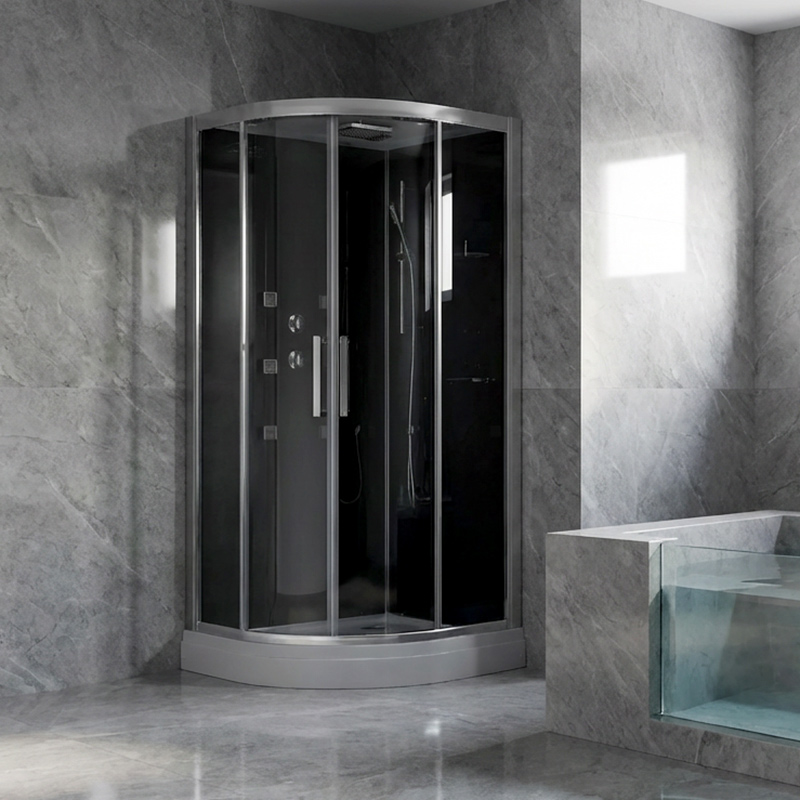
1. What a “Quadrant” Actually Is (Quick Refresher)
A quadrant enclosure sits in the corner of the room, with two straight walls forming a 90° angle, and the shower door following a curved (radiused) profile — usually 800mm, 900mm, or 1000mm radius.
Configuration options:
- Single sliding door on the curve (most common for condos)
- Double sliding (both panels move — easier access, more hardware cost)
- Curved fixed panel + hinged door (rarer, more “lux” feel but needs swing clearance)
The footprint is typically sold as:
- 800mm quadrant = ~800×800mm straight-wall footprint → fits tiny ensuites
- 900mm quadrant = ~900×900mm → sweet spot for SEA condos
- 1000mm quadrant = ~1000×1000mm → premium master ensuite
”Quadrant” = quarter-circle. “Sector” is sometimes used interchangeably, though purists argue sector = shallower curve / different wall-angle. In the shower industry, if it’s a radiused door in a corner, everyone calls it a quadrant.
2. Why Master Bedroom Ensuites = Quadrant Territory
Let’s do the spatial math that architects do at 2am.
The space efficiency argument
A square 900×900mm enclosure (two glass panels + hinged door) needs:
- Door swing clearance: ~600mm arc in front of the door
- In a 1.5m² ensuite, that “swing zone” eats the vanity or the WC approach
A 900mm quadrant (footprint same 900×900mm) gives you:
- Sliding door on the curve → zero swing clearance needed
- Same showering space felt inside (the radius actually gives shoulder room at the back wall)
- Outer “nose” of the curve protrudes less into the room than a hinged door’s swing arc would
| Enclosure Type | Footprint | Door Clearance Needed | Feels Like (inside) |
|---|---|---|---|
| Square, hinged | 900×900 | 600mm swing | 900×900 |
| Quadrant, slider | 900×900 | 0mm | ~equivalent (curved wall adds shoulder width) |
| Rectangle 800×1200, slider | 800×1200 | 0mm | bigger, but needs longer wall |
In a master bedroom ensuite where the shower is wedged beside the WC and vanity, the quadrant wins on clearance every time.
The “Midnight Geometry” factor (why couples argue less)
Master bedroom = the one people actually use at 2am. A hinged door that swings into the vanity knee-space, or a slider on a rectangle that’s 1200mm long eating the WC side — both create friction.
Quadrant’s sliding door opens along the radius, meaning:
- You slide it 400–450mm and step in
- The “opening arc” is inside the shower footprint, not outside it
- Partner can brush teeth at vanity while you shower — door doesn’t hit their elbow
Small detail. High marital value.
3. Why Quadrants Beat the Alternatives in Condo Ensuites
vs. Rectangular Slider (800×1200 / 900×1200)
Rectangle gives more shower depth, yes. But:
- Needs one wall that’s 1200mm clear → many SEA condo ensuites are square-ish (the corner allocation from the developer)
- Rectangle slider’s outer profile runs 1200mm along the room → visually “longer” in a small space, feels cramped
- Quadrant tucks tighter into the corner, leaves more floor visible → room reads “bigger”
vs. Square Corner Enclosure (two fixed + hinged door)
- Hinged door slams into the vanity / WC if the architect didn’t allow 600mm
- In practice, many “square corner” units in SEA condos can’t use a hinged door — the WC is 350mm from the shower corner
- Quadrant slider bypasses this entirely
vs. Walk-in Screen (fixed panel only)
- Walk-in = water everywhere in a 1.4m² room
- Quadrant = enclosed on three sides (two walls + curved door) → water stays in
- Master ensuite resale value: buyers expect “proper enclosure,” not a screen that wets the toilet roll
4. The Developer’s Perspective: BOM & Speed
If you’re supplying to a condo developer (50–200 units per block, common in BKK/SG/KL), quadrants have three commercial advantages:
A. Lower glazing cost than frameless
A quadrant uses:
- One curved door panel (tempered, rolled to radius — yes, this costs more per panel than flat glass)
- One or two straight fixed panels (cheaper than frameless’s heavy 10mm+)
- Aluminum profiles (curved header/threshold + straight wall profiles)
Total glass weight < equivalent frameless. For a 900mm quadrant, you’re often at 6mm curved door + 6mm fixed (EN 12150 minimum for 6mm is fine here because the curve itself adds stiffness). Frameless corner would need 8–10mm. Glass cost difference: ~15–22% per unit.
B. Faster install
Quadrants are kit products — pre-cut radius, pre-drilled profiles, gaskets standardized. An installer can set a quadrant in 45–70 minutes. A custom frameless corner with hinges and strikes? 2–3 hours, plus silicone cure checks. On a 150-unit block, that’s ~200 labor hours saved.
C. Tolerance forgiveness
Condo walls are rarely 90.00°. Quadrant wall profiles have in-out adjustment (typically ±10–15mm per side) via the wall channel. Frameless in a corner needs precise glass-to-glass clamps and a very square wall, or you’re shimming the hell out of it. Quadrant absorbs the “builder’s 88° corner” without drama.
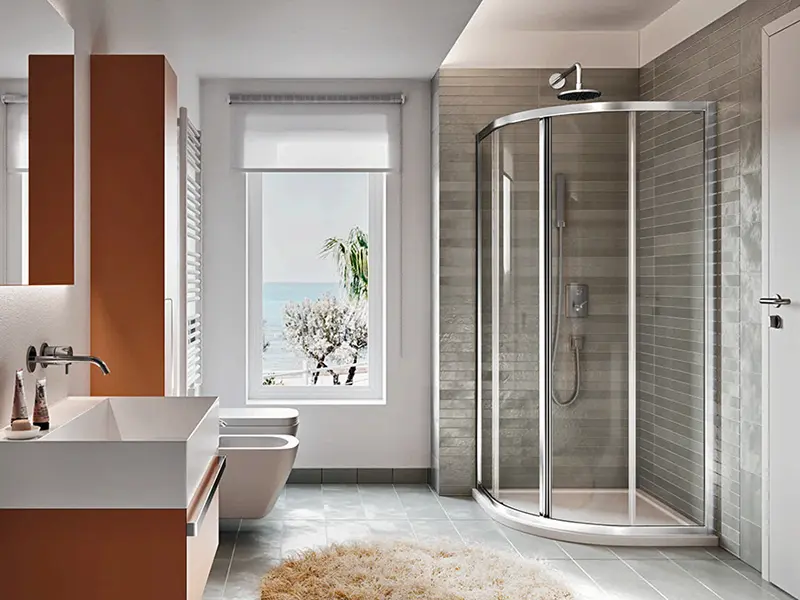
5. Specifying Quadrants for Tropical High-Rise (What Importers Must Check)
A quadrant bought for a Manchester semi-detached will not survive a Bangkok condo without a few tweaks. Here’s the tropical/high-rise spec sheet:
A. Curved door roller quality (the #1 failure point)
The curved door runs on a top rail (usually aluminum extrusion, radiused) and bottom guides.
- Cheap: nylon rollers on a thin rail → after 12 months in humid condo, the nylon swells, the rail oxidizes (if not 304 or anodized), door drags
- Right spec: 304 stainless ball-bearing rollers, dual-wheel, anti-jump clip on top rail, bottom guide with nylon insert (replaceable)
In high-rise condos (vibration, remember our earlier article?), the “anti-jump” clip matters — building sway can make a loose roller jump the curved rail. Tenant calls management. Management calls you.
B. Threshold (tray interface)
Quadrants almost always sit on a shower tray (not wet-room floor) in condos — easier waterproofing, faster install.
- Stone resin tray + quadrant = premium feel (Thai/VN developers love this combo)
- Acrylic tray + quadrant = cost play (entry-level SG/BKK projects)
- Threshold seal: the curved door bottom needs a sweep + magnetic/lip seal where the door meets the curved threshold. If that seal flattens (cheap PVC), water creeps under → leaks onto the bedroom carpet (yes, really, seen it in KL).
C. Radius tolerance & glass thickness
- Curved panel: 6mm minimum (EN 12150). The rolling process relieves some stress, but you still need proper temper. Ask supplier: “What’s your rejection rate on curved temper?” (Anything >5% = furnace not dialed.)
- Radius accuracy: A 900mm quadrant should have the door tracking smoothly at any points along the curve. If the radius varies ±5mm along the arc (bad rolling), the door will bind at the “tight” spot. Test: slide door open/closed 10x during QC.
D. Profile finish (tropical corrosion)
- Anodized aluminum (10–15 micron) = minimum for inland condos
- 304 stainless capped profiles or 304 clips over aluminum = coastal condos (Phuket, Singapore east coast, Penang)
- Powder-coat over aluminum = okay if the coat is >70 micron and the edge prep is good (cheap powder coat chips at the radius bend → aluminum under corrodes in 18 months)
6. Sizing Guide: Which Radius for Which Master Bedroom?
| Condo Tier | Ensuite Size (typical) | Quadrant Size | Why |
|---|---|---|---|
| Entry / mass market | 1.1–1.3 m² | 800mm Q | Fits; vanity + WC still work |
| Mid-range / city center | 1.4–1.7 m² | 900mm Q | Sweet spot; most common SG/BKK spec |
| Premium / penthouse | 1.8–2.2 m² | 1000mm Q | Feels generous; couples can share morning routine |
| Luxury + tub kept | 2.0m²+ | 900mm Q + separate tub | Quads stay compact; tub takes the rest |
Rule of thumb for SEA developers: 900mm quadrant = the default. 800mm feels cramped for a 175cm+ male (common in Western expat tenant market); 1000mm starts eating vanity space in a “standard” 1.6m² ensuite.
7. Common Quadrant Complaints (And How to Avoid Them at Spec Stage)
| Complaint | Root Cause | Fix at Spec |
|---|---|---|
| “Door is hard to slide” | Roller swelled / rail corroded / radius inconsistent | 304 ball-bearing rollers, anodized 15μ+ rail |
| “Water leaks at curve-threshold joint” | Bottom sweep + threshold seal cheap / compressed | Dual-fin sweep, replaceable threshold lip seal |
| “Squeaks at night (high-rise)” | Roller on dry rail, building sway | Roller with nylon outer + periodic silicone lube; anti-jump clip |
| “Glass looks wavy at the curve” | Bad temper/rolling, optical distortion | Request “optical grade” curved temper; sample approval before PO |
| “Profile rusted at 14 months (coastal)” | Anodized too thin / powder coat chipped | 304 stainless capped or PVD finish |
8. The “Master Bedroom” Aesthetic Angle (Don’t Ignore This)
Quadrants have a reputation for being “practical, not pretty.” That’s outdated.
Modern quadrant designs for master bedrooms:
- Matt black curved rail + smoked glass (very KL/SG hipster-luxury)
- Brushed gold PVD hardware + clear curved glass (Bangkok high-end)
- Frameless-look quadrant — slim-profile aluminum (10mm face instead of 20mm), curved door still tempered 6mm but the profile is minimal. Reads “almost frameless” from the pillow line (master bedroom door often left open → you see the ensuite from bed)
If you’re pitching to interior designers on condo fit-outs, bring the aesthetic quadrant, not the builder-basic one. The BOM difference is ~$25–40/unit. The designer will spec you across the whole block.
9. Installation Tips Specific to Quadrants (Contractor-Friendly)
- Level the tray FIRST — the curved rail sits on the top of the two wall profiles; if the tray is out level, the door drifts. Quadrants are more sensitive to tray level than squares because the curved door’s weight is constantly pulling along the rail.
- Wall channels: silicone behind AND outside — same high-rise rule from our earlier article. The curved rail transfers vibration to the wall posts; if the silicone behind fails, the post ticks against the tile.
- Radius reveal: the curved door should have 3–5mm gap from the straight fixed panel at the top, closing to ~1–2mm at the bottom (magnetic strike). If the gap is parallel top-to-bottom, the door is too square (rare) — usually it’s the other way (bottom gap too big = door sag on rollers).
10. When NOT to Use a Quadrant
Be honest with your buyer:
- Wet-room spec (tiled floor, linear drain) → quadrant needs a tray, doesn’t make sense
- Accessible / elderly (wheelchair) → threshold of a quadrant tray is ~40–50mm (even “low threshold” is ~25mm). Not barrier-free. Use a walk-in with ramped tray instead.
- Very large ensuite (>2.5m²) where the architect wants a “statement” → frameless rectangle or steam cabin competes better
Conclusion: The Unsung Workhorse of the Condo Skyline
In the hierarchy of shower enclosures, quadrants don’t get the Instagram likes that frameless walk-ins do. But if you look at the skyline of Bangkok, Singapore, or KL — at the 30th-floor master bedroom where a couple gets ready for work — the odds are high the shower tucked in that corner is a quadrant.
Because it fits. Because it slides quietly at 6am. Because the developer’s BOM team can buy 200 of them and the installers will finish on schedule. Because in a 1.5m² room, “pretty enough” plus “zero swing clearance” beats “architectural statement” nine times out of ten.
At Zhongshan Weichen Sanitary Ware Co., Ltd., our quadrant series is built for exactly this: 304 ball-bearing rollers as standard, radiused rails matched to ±2mm tolerance, stone-resin tray compatibility, and profile finishes from anodized matte black to PVD brushed gold. We stock 800/900/1000mm radii for SEA condo lead times, and we’ll sample-match radius to your architect’s drawing before you commit the block.
Post time: Jun-29-2026