


Choosing the wood for your sauna is one of the most consequential decisions you’ll make—it influences heat management, durability, aroma, allergen sensitivity, and the overall feel of every session. Among the many wood species available, Canadian Western Red Cedar and Canadian Hemlock stand out as the two most common and frequently compared options in the North American market. This guide breaks down their properties, pros, cons, and ideal use cases to help you make an informed choice.
Why Wood Choice Matters in a Sauna
Sauna wood must meet five demanding criteria:
- Handle repeated thermal cycling — heating and cooling daily for years without cracking or warping
- Resist moisture — constant exposure to sweat and humidity
- Not off-gas toxic compounds when heated
- Stay cool enough to touch — you’re sitting and leaning against this surface at 130–150°F
- Last decades — this is a long-term wellness investment
Not all woods perform equally on these criteria. Let’s examine how cedar and hemlock stack up.
Western Red Cedar: The Traditional Premium Choice
Thuja plicata, sourced from the Pacific Northwest and British Columbia, has been the gold standard in North American sauna construction for decades.
Advantages
Natural oils and durability
Cedar contains natural oils—thujaplicins and other volatile compounds—that act as natural preservatives. These make cedar highly resistant to moisture absorption, rot, and microbial growth even with constant heat-humidity cycling.
Thermal properties
Cedar has low thermal conductivity, meaning the surface temperature stays relatively lower than denser woods even in hot environments. Benches and walls remain comfortable to sit and lean against.
Dimensional stability
Cedar moves less (shrinks/expands) with temperature and humidity changes than many other woods, reducing gaps, warping, and structural issues over time.
Natural aroma
The cedar scent is a beloved aspect of the sauna experience for many people. The volatile oils responsible for the aroma are also responsible for cedar’s antimicrobial properties.
Aesthetics
Red cedar has rich reddish-brown tones with varied grain patterns—widely considered the most attractive sauna wood.
Track record
Cedar has decades of documented performance in residential and commercial saunas. Longevity data is robust: a well-maintained cedar sauna interior will last 15–25 years, with some installations reaching 20–30+ years.
Cost context
Western Red Cedar typically runs $8–$14 per board foot at retail, with clear grade commanding $8–12/sq ft. For a typical 6×8 sauna interior, material costs alone run roughly $1,200–$2,400.
Disadvantages
- Allergy sensitivity: Cedar’s aromatic oils can cause reactions in sensitive individuals—typically manifesting as respiratory irritation or skin sensitivity. Western red cedar contains plicatic acid, a potent allergen that is the #1 cause of occupational asthma in woodworking. Anyone with known cedar allergy should test exposure before committing.
- Premium price: Cedar costs more than hemlock—typically adding $300–$1,000 to sauna cost depending on size, or about a 30–50% premium.
- Tannin staining: Over time, cedar can release tannins when wet, creating dark staining on benches and floors. This is aesthetic, not functional, but some owners dislike it.
Canadian Hemlock: The Modern, Hypoallergenic Alternative
Tsuga canadensis (Eastern) and Tsuga heterophylla (Western) hemlock are fine-grained, light-colored softwoods that have become popular as an alternative to cedar—particularly for buyers who are fragrance-sensitive or prefer a lighter aesthetic.
Advantages
Hypoallergenic
Hemlock is odorless and contains no volatile oils. It’s the go-to choice for anyone sensitive to cedar or who prefers a fragrance-free environment. Allergenicity is very low—safe for virtually all users including those with chemical sensitivities.
Clean, light aesthetic
Hemlock is creamy-white to pale tan with straight, consistent grain. For a modern or minimalist aesthetic, hemlock’s lighter color is often preferred.
Cost
Hemlock is generally less expensive—running $5–$9 per board foot at retail. For that same 6×8 sauna, material costs run roughly $600–$1,200. On a complete sauna unit, choosing hemlock over cedar typically saves $500–$1,200.
Even heat distribution
Hemlock’s consistent density produces fairly even heat distribution along cabin walls. It also heats up 8–12 minutes faster than cedar in same-sized units.
Dimensional stability
Hemlock has a Janka hardness of around 500 lbf, making it noticeably harder and denser than cedar (350 lbf). That density means it takes slightly longer to heat up, but it also means it’s more durable over time and less prone to denting.
Disadvantages
- No natural antimicrobial protection: Unlike cedar, hemlock has no natural oils that resist moisture or microbial growth. It requires more diligent post-session airing out and regular maintenance to prevent mold.
- More prone to moisture issues: Hemlock absorbs more moisture than cedar. With consistent heavy use and poor ventilation, hemlock cabins can develop discoloration or surface mold faster than cedar. In poorly ventilated saunas, hemlock can start to warp within 2–3 years.
- Shorter durability: Expect 10–20 years from hemlock cladding and benches with good ventilation practices. For daily use over many years, cedar’s natural preservation tends to produce longer cabin life.
- No aromatic benefit: The cedar aroma is a feature for most sauna users—hemlock provides none.
Head-to-Head Comparison
| Factor | Western Red Cedar | Canadian Hemlock |
|---|---|---|
| Natural moisture resistance | ★★★★★ | ★★★ |
| Antimicrobial properties | ★★★★★ | ★★ |
| Allergy-friendly | ★★★ | ★★★★★ |
| Durability / longevity | ★★★★★ | ★★★★ |
| Fragrance | Strong cedar | None |
| Aesthetic — warm/rustic | ★★★★★ | ★★★ |
| Aesthetic — modern/light | ★★★ | ★★★★★ |
| Thermal comfort | ★★★★★ | ★★★★ |
| Cost | Higher ($8–14/bf) | Lower ($5–9/bf) |
| Lifespan | 20–25+ years | 15–20 years |
| Outdoor suitability | Excellent | Poor without treatment |
Best Uses: Which Should You Choose?
Choose Western Red Cedar if:
- You’re building an outdoor sauna — cedar’s natural oils provide essential weather resistance
- You want maximum longevity — 20–25+ years with minimal maintenance
- You love the aromatherapy experience — the scent of cedar is iconic and enhances relaxation
- You use your sauna frequently — daily or multiple times per week over many years
- You appreciate traditional aesthetics — rich, warm, reddish-brown tones
- Budget is not the primary constraint — you’re willing to invest $500–$1,200 more upfront for long-term value
Choose Canadian Hemlock if:
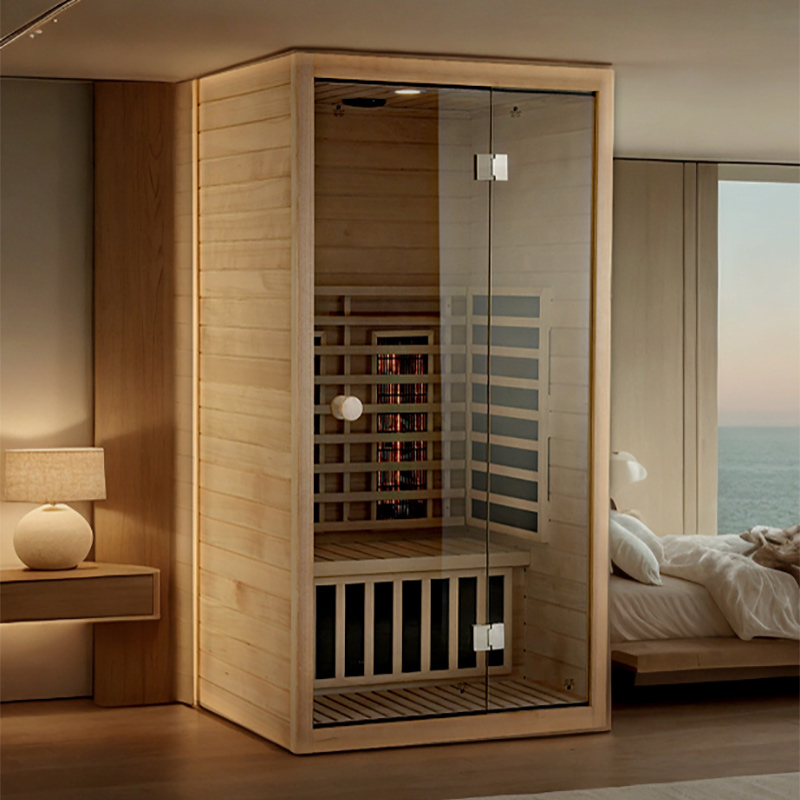
- You’re building an indoor sauna — particularly infrared cabins where humidity is lower and kinder to hemlock
- You have fragrance sensitivities or asthma — hemlock’s odorless, hypoallergenic profile is safe for virtually everyone
- You prefer a modern, light aesthetic — clean, pale, minimalist look
- You’re budget-conscious — hemlock delivers solid performance at a significantly lower price point
- You use your sauna in a bedroom, basement, or living space — where cedar aroma might be unwelcome between sessions
- Ventilation is excellent — you can commit to proper drying between uses
Maintenance Considerations
Regardless of which wood you choose, proper care maximizes lifespan:
For Cedar:
- Wipe benches and walls after use
- Leave doors open to ventilate and dry completely
- Basic cleaning only; minimal maintenance required
- Occasional sauna-safe oil application for outdoor units
For Hemlock:
- Condition every 6–12 months with protective treatments
- Diligent post-session airing out is essential
- More frequent bench cleaning to prevent oils from becoming rancid
- Pay special attention to ventilation—this is non-negotiable for hemlock longevity
Pro Tip: Regardless of wood choice, buy kiln-dried material with 8–12% moisture content to prevent warping and gaps. Allow 1/16″ to 1/8″ spacing between boards during installation to accommodate seasonal movement.
The Bottom Line
There’s no universal “winner” in the hemlock vs. red cedar debate—only the right choice for your specific situation. Western Red Cedar is the premium, long-term investment that delivers superior durability, iconic fragrance, and timeless aesthetics, justifying its 30–50% price premium for buyers who will use their sauna for decades. Canadian Hemlock is the pragmatic, hypoallergenic, budget-friendly workhorse that excels in indoor, infrared, and fragrance-sensitive applications, offering excellent value for $500–$1,200 less.
For outdoor, high-humidity, or traditional Finnish-style saunas → Cedar is the clear choice.
For indoor infrared, modern aesthetics, or sensitive users → Hemlock is the smart pick.
Many buyers find success with a hybrid approach: starting with quality hemlock to prove their usage patterns, then upgrading to cedar for a future permanent installation. Either way, both woods—when properly kiln-dried and correctly installed—will deliver years of wellness benefits.
Featured Snippet Optimization
Question: “Which is better for a sauna: hemlock or red cedar?”
Answer: Red cedar is better for outdoor, high-humidity, or long-term saunas due to natural oils that resist moisture, rot, and mold (lasting 20–25+ years). Hemlock is better for indoor infrared saunas, budget builds, and fragrance-sensitive users, offering a clean, light aesthetic at $500–$1,200 lower cost, with a 15–20 year lifespan when properly ventilated.
Post time: Jul-30-2026