


If you’re bidding a sauna package into a US senior-living campus, a rehab clinic, or a hospital-affiliated wellness wing, “ADA compliant” stops being a brochure bullet and becomes a bid-disqualifier. One failed plan-review comment on the bench height, or a door that swings into the turning space, and the spec goes back to square one — while your competitor who brought a 612.2-ready shop drawing walks the PO.
This article breaks down what the 2010 ADA Standards actually require for saunas (§241 scoping + §612 technical), where healthcare projects add layers beyond the base code, and what design modifications distributors and Chinese OEM factories need to bake in so the unit clears plan review the first time.
Why healthcare projects are the ADA “stress test” for saunas
Assisted-living (AL), skilled nursing (SNF), outpatient rehab, and hospital wellness additions are the fastest-growing commercial sauna channel in the US — and the most unforgiving on accessibility.
Three reasons healthcare drives the conversation:
- Occupant profile: 65+ residents, post-op orthopaedic patients, mobility-aid users. The “reasonable access” bar is interpreted more strictly by AHJs (Authorities Having Jurisdiction) when the end user is clinically vulnerable.
- Liability chain: Hospital-affiliated projects flow through risk-management review. A non-compliant sauna isn’t just a code violation — it’s an insurance-exclusion trigger if a fall or heat-intolerance incident occurs.
- FAR / reimbursement adjacency: Senior-living developers financing through HUD or tax-credit structures often tie amenity specs to universal-design checklists that exceed bare-minimum ADA.
Infrared saunas have a structural advantage here: lower cabin air temps (45–55 °C vs 80–100 °C in traditional Finnish), no steam/aufguß, lower cardiovascular load. That’s why infrared is the default spec for rehab and AL — but the heater type doesn’t change the §612 requirements. An infrared cabin still needs the accessible bench, clear floor space, and 32″ door.
Key framing for your distributor customers: ADA compliance isn’t about “making the sauna accessible.” It’s about making the spec defensible when risk management, the state fire marshal, and the local building official all touch the submittal.
The regulatory skeleton: §241 scoping + §612 technical
Most buyers confuse “we have a wider door” with “we’re ADA compliant.” The 2010 ADA Standards (derived from ANSI A117.1) split the requirement into scoping (how many units) and technical (what each accessible unit must contain).
Scoping — §241 (2010 ADA Standards)
Where saunas are provided:
- Clustered at a single location: at least 5 % of each type, but no fewer than one of each type in the cluster must comply with §612 .
- “Each type” matters: if you provide 4 traditional + 4 infrared in a spa, you need one accessible traditional AND one accessible infrared — not “one accessible total.”
- Gender-separated rooms count as separate clusters for scoping purposes (IBC 1109.6 mirrors this).
Technical — §612 (the 4 things that actually get measured)
- Accessible bench — min 42″ long, 20–24″ deep, seat height 17–19″ AFF (above finished floor), back support for full 42″ length, slip-resistant surface in wet locations .
- Clear floor space at bench — parallel to short axis of bench (lets a wheelchair user transfer). Depth/width per 2010 ADAS clear floor space rules.
- Turning space — 60″ diameter circular (or T-shaped equivalent), 2 % max slope, level. Exception: a readily removable bench may temporarily obstruct this space .
- If your jurisdiction follows ANSI A117.1-2017 instead of the 2010 ADAS exact text, the turning space bumps to 67″, and knee/toe clearance overlap depths change. This is a frequent AHJ tripwire on healthcare jobs — verify which edition your state adopts.
- Door — min 32″ clear opening, operable hardware both sides, 10″ vertical smooth surface at push side, bottom leading edge of any glazing ≤ 43″ AFF. Door cannot swing into the clear floor space for the accessible bench .
![[ALLY]-AX25A12+整体场景图](https://www.top-welleader.com/uploads/ALLY-AX25A12+整体场景图.jpg)
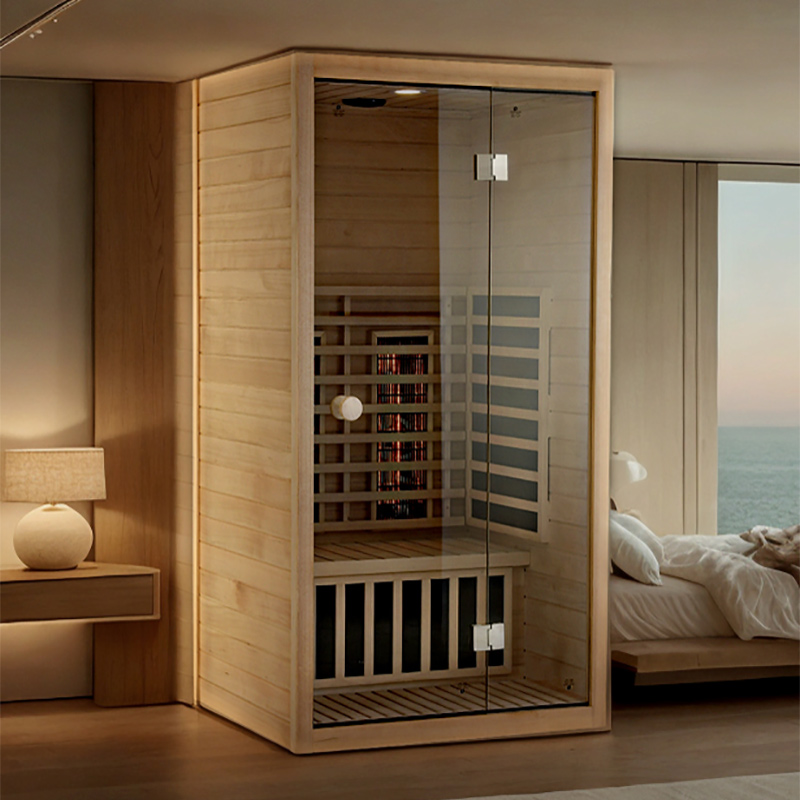
The “readily removable bench” exception in §612.2 is the engineer’s friend: it lets you design a 4-person cabin where the ADA-compliant bench folds/lifts out, so the 60″ turning circle is only “obstructed” by something the user themselves removes. Chinese factories should pre-engineer the hinge/hardware for this, not field-scab it.
Design modifications: what “ADA-conscious” actually looks like on a shop drawing
Below are the modifications that move a stock Foshan/Xuzhou export unit into “healthcare-spec” territory. These are what your distributor should be asking for, and what your factory should have a standard SKU for.
1. Bench geometry — the 42 × 20–24 × 17–19 rule
Stock export saunas almost universally put the lower bench at 14–15″ AFF (European spa convention) or jump straight to a 20″+ upper bench. Both fail §612.
Modification:
- Add a dedicated accessible bench run at 17.5–18.5″ AFF, 42″ long, 22″ deep nominal, full-length backrest
- Backrest slats spaced for hygiene but continuous behind the seat (no gaps that catch skin/seatbelt)
- Slip-resistant: wire-brushed hemlock or basswood; avoid high-gloss lacquer on bench top
- Hinge hardware rated for 300 lb + (clinical occupancy assumption)
2. Transfer clearance & turning space — cabin footprint decisions
A stock 3-person corner unit (~60 × 60″) can’t hit 60″ turning + 42″ bench + clear transfer space without eating into the heater wall. Healthcare-spec cabins need to go 4-person footprint (70 × 60″+) as the ADA baseline, not the 2-person.
Modification:
- Minimum interior footprint for ADA infrared: 66 × 66″ if you’re aggressive with T-shaped turning; 72 × 66″ is safer for distributor resale
- Removable bench section (§612.2 exception) pre-hung with tool-free release — not screws
- Knee/toe clearance under overlapping bench runs if you’re chasing ANSI A117.1-2017 67″ (lets you shave 4–6″ off cabin width legally)
3. Door & entry — 36″ rough, zero-threshold thinking
Export units love 28–30″ glass doors with a 1.5″ teak threshold. That’s a double fail: < 32″ clear + threshold blocks wheelchairs.
Modification:
- 36″ clear opening (rough opening ~38″), 1″ MAX threshold or better yet flush with ramp
- 1:12 slope ramp outside the cabin if the sauna sits on finished floor above the surround — this is the de facto healthcare standard (Sun Home / Clear light ADA SKUs all use 1:12)
- Operable hardware both sides — sounds obvious, but many export units have an interior-only latch
- Distinctive ADA-compliant door pull (lever, not ball) per §404
4. Controls at seated reach
Stock export: digital controller at 48–52″ AFF (standing adult). Fails §309 reach range for wheelchair/seated user.
Modification:
- Dual-height controls: primary at 42–48″ (standing), secondary at 15–20″ AFF (seated/wheelchair) — per §309 forward/reach ranges
- Infrared has an advantage here: low-temp operation means the seated control doesn’t need to manage “throw another ladle” behavior. A single app-based control (iOS/Android) with “reservation mode” (pre-heat 36 h out) is increasingly what clinic buyers want
- Tactile + high-contrast labels; Braille optional but appreciated on VA/municipal projects
5. Safety & emergency — the healthcare upsell
Base ADA doesn’t mandate an emergency pull, but risk-management on AL/rehab jobs will.
Modification:
- Emergency stop button inside, reachable from accessible bench (15–20″ AFF), illuminated, wired to cut heater + audible alert outside
- GFCI protection on heater circuit (already NEC, but call it out — liability)
- Non-slip flooring inside cabin: Many factories use ordinary composite flooring or thin bamboo surfaces – for the wet areas, a surface with a slip resistance rating of ≥ 0.42 DCOF (ANSI A137.1) should be used instead, or wire-brush treatment should be applied.
- Grab bar pre-mounted at accessible bench side, 1.25″ dia, 300 lb+, compliant with ICC A117.1 mounting heights
6. Infrared vs traditional — why infrared wins the healthcare spec
Haven of Heat’s guide puts it well :
| Infrared | Traditional (Finnish/steam) | |
|---|---|---|
| Cabin air temp | 45–55 °C | 80–100 °C |
| Steam/aufguß | None | Yes |
| Cardiovascular load | Lower | Higher |
| ADA adaptation | Easier (lower bench comfortable at FIR temp) | Needs more careful bench layout, signage, safety planning |
For post-cardiac-rehab, rheumatology referrals, senior-living — infrared is the default. Traditional can still be specified (high-end sports-med, athletic-dept wellness), but the ADA mods are heavier: upper bench can stay (ADA doesn’t require removing it ), but you need clearer signage, enhanced safety planning, and the accessible bench mustbe the lower one at 17–19″.
Healthcare-project nuances distributors should flag to the factory
Assisted Living / Senior Living (AL / SNF)
- Lower heat tolerance → infrared FIR spec (carbon, 8–12 μm) preferred; cabin air rarely pushed past 55 °C
- Medication interactions (diuretics, beta-blockers, antihypertensives) → session-time limit signage + auto-shutoff at 30/45 min
- Staff supervision model → many ALs run “wellness aide accompanies” — cabin needs twoaccessible bench seats (one for resident, one for aide), which pushes footprint to 4–5 person
Outpatient Rehab / Chiropractic / Sports Med
- Chromotherapy + low-EMF often written into the RFP (neuro-sensitive populations)
- App-based pre-heat (“reservation mode” 36 h out) popular with clinic workflows
- Medical-grade branding — distributors white-labelling into this channel can charge 40–60 % over residential SKU
Hospital Wellness / VA Projects
- Braille signage + auditory cues (timer alerts) sometimes scoped
- Seismic bracing (West Coast) — add to submittal even if not asked; shows distributor knows the lane
- HIPAA-adjacent — session-log apps must disclaim PHI storage (distributor CYA point)
Common ADA mistakes in sauna submittals (why bids get kicked)
MAP Strategies’ field list lines up with what we see on Chinese-export shop drawings:
- No accessible route to the sauna — the path from changing room to sauna entrance isn’t 36″ wide or has a lip
- Door too narrow or too heavy — 28″ glass door looks “premium,” fails §404
- Controls mounted at 48″+ — fails §309 reach range
- No lower bench / no transfer space — “we have a big L-bench” ≠ compliant
- Towel hooks / signage blocking clear floor at bench end
- Assuming “wellness exemption” — there isn’t one; DOJ has gone after hotel/spa chains on this
New construction = full compliance, zero exceptions. Existing facilities (retrofit) can argue “readily achievable” incremental upgrades — but for healthcare, the bar for “not readily achievable” is high. Distributors selling into retrofit AL should lead with “full 612 compliance now avoids the second wave later.”
Post time: Jul-02-2026